Wednesday, 24 April 2024
The Amazing Race 36, Episode 7
Córdoba (Argentina) - Montevideo (Uruguay)
It’s been twenty years since The Amazing Race made its only previous visit to Uruguay in Season 5, despite multiple visits by to neighboring countries by the world travel “reality”-TV show.
That’s in line with patterns of real-world travel, especially backpacker travel. As the wealthiest country on the continent, Uruguay has become for travellers on a budget what Argentina was before the devaluation of the Argentine peso during the financial crisis of 2001: interesting and potentially attractive, but too expensive to justify more than a brief visit except by those for whom price is little object.
Montevideo is the most expensive large city in South America. Uruguay’s primary tourist destination, the smaller but glitzier beach and casino resort of Punta del Este, is even more pricey, making it a Southern Hemisphere counterpart of the Côte d’Azur.
Long-term travellers and digital nomads are most likely to visit Uruguay, as I did, only as a weekend getaway and/or on a visa run across the mouth of the River Plate estuary to get a new 90-day entry permit to Argentina. Although the duration of permitted entries is at the discretion of immigration officers at the border crossing, ferry port, or airport, visitors with passports from the USA or most other First World countries can, in practice, live in Argentina for extended periods as “tourists” as long as they leave the country, and re-enter, every 90 days or less. Many of those making visa runs from Buenos Aires choose to spend at least a night in Montevideo or Colonia del Sacramento, both of which are served by ferries from Argentina, although you can make a round trip in a day on either of the high-speed ferries.
Fittingly, the first challenge for the racers was staged at the working commercial port that’s Montevideo’s raison d’être and major advantage, even today, over its much larger rival Buenos Aires across the estuary. Montevideo, at the foot of rocky promontory near the mouth of the river, has a natural deep-water harbor. Buenos Aires is located along a gently sloping, marshy stretch of shoreline further upriver, and its port requires constant dredging. Montevideo’s container port, in particular, remains a significant competitor of ports in neighboring countries despite Uruguay’s much smaller size.
The racers found another of their clues in the plaza next to the Mercado del Puerto in the Ciudad Vieja (old city), but missed seeing what was inside. As with some other “public markets”, the attraction is as much the cooked-food stalls — really an array of restaurants under one roof — as the stalls selling meat, fish, cheeses, and produce. Angelenos familiar with the Grand Central Market in downtown L.A. will understand the concept, although the market in Montevideo is larger. As I noted when The Amazing Race 5 passed through Montevideo, “One of the best meals in my life was… at the restaurant El Palenque in the Mercado del Puerto, while waiting for the high-speed ferry to Buenos Aires to depart from the terminal across the road.”
Some of the racers’ greatest difficulties in this episode were in driving and navigation. Unlike Buenos Aires, Santiago, São Paulo, or Rio de Janeiro, Montevideo has neither a Subte or Metro nor a suburban railway system — not even a train along the strip of densest development between Montevideo and Punta del Este, although a light rail line along the coast within metropolitan Montevideo is under consideration. There are buses, of course, and the historic and touristic Ciudad Vieja is walkable, but despite the much greater size of greater Buenos Aires, the Subte makes it easier to explore without a car than greater Montevideo including the long string of beachfront neighborhoods and outlying towns that extend out from the city center.
The racers’ troubles on the streets of Montevideo were exacerbated, for some of them, by their having to drive stick-shift rental cars. Whether or not you’re in a race and required to drive whatever vehicle you are assigned, there are times and places, not always predictable, where the only available vehicles will have manual gearshifts. Do yourself a favor: Before you set off on a trip around the world on which might want to rent a vehicle, learn to drive a stick-shift car on familiar roads (or in a large empty parking lot to start) at home. Don’t put yourself in the position of trying to learn to shift and clutch for the first time while you are also dealing with unfamiliar traffic patterns, signs in an unfamiliar language, and perhaps driving on the opposite side of the road than you are used to.
Tuesday, 23 April 2024
California Senate puts Selective Service bill "in suspense"
After hearings on its policy and fiscal implications, the California Senate has deferred action on a bill to automatically register draft-age applicants for driver’s licenses and state IDs with the Selective Service System for a possible future military draft, by placing the bill on the Senate Appropriations Committee “suspense file”. This means that unless the Senate Appropriations Committee decides by 17 May 2024 to call up the bill and forward it to the state Senate floor, the bill will be dead.
The Acting Director of the Selective Service System (who had been on the West Coast to swear in a new Washington State Director of Selective Service) and the Deputy Associate SSS Director for Legislative Affairs spent several days in Sacramento lobbying state Senators in support of SB-1081. The Acting SSS Director was the lead witness in support of SB-1081 at the Senate Transportation Committee hearing on 9 April 2024.
The Senate Transportation Committee voted 12-2 (with one Democratic and one Republican member in opposition, and another Democratic member not voting) to send SB-1081 on to the Senate Appropriations Committee, which held its own perfunctory hearing on 22 April 2024 before placing SB-1081 on its “suspense file” by unanimous consent.
In California, bills that would result in significant costs to the state are placed on the “suspense file” to allow fiscal priorities for the state budget to be determined. Decisions as to which bills to call up for further action, and which to allow to die “in suspense”, are typically made behind closed doors by State senate leaders — especially the Senate President pro tem — and the Chair and members of the Senate Appropriations Committee.
SB-1081 could be called up from the suspense file and sent to the state Senate floor at any time, but most likely it will be considered along with all the other bills in the suspense file at a “suspense hearing” shortly before the 17 May 2024 deadline.
The lobbying visit to Sacramento by the top national officials of the SSS reflects the existential importance of this bill to the attempt by the SSS to rescue the system from failure and save their agency and their own jobs from elimination. Especially since the repeal of laws that used to condition Federal and California financial aid for higher education on draft registration, the SSS depends primarily on state laws like SB-1081 to coerce or trick young men into signing up for a possible future draft when they think they are merely signing up for a driver’s license, without legal counsel and often without realizing what is happening or its potential life-or-death consequences.
California has rejected bills like this at least seven times since 2000, but the Selective Slavery System and supporters of military conscription won’t give up.
It’s important for opponents of military conscription to contact the California Senate President pro tem and the Chair and members of the Appropriations Committee as soon as possible, and before the 17 May 2024 deadline for action on bills in the suspense file at the latest. Tell them you oppose SB-1081 and urge them to “Leave SB-1081 in the suspense file”.
Fiscal arguments may not have much to do with what’s fundamentally wrong with the draft and draft registration, but they seem to be more likely to sway legislators (and the Governor, if the bill makes it to his desk; Governor Brown vetoed a similar bill in 2015).
Here are templates for individual and organizational e-mail messages you can customize. There are more arguments here and below against SB-1081:
Continue reading "California Senate puts Selective Service bill "in suspense""Wednesday, 17 April 2024
The Amazing Race 36, Episode 6
Santiago (Chile) - Córdoba (Argentina)
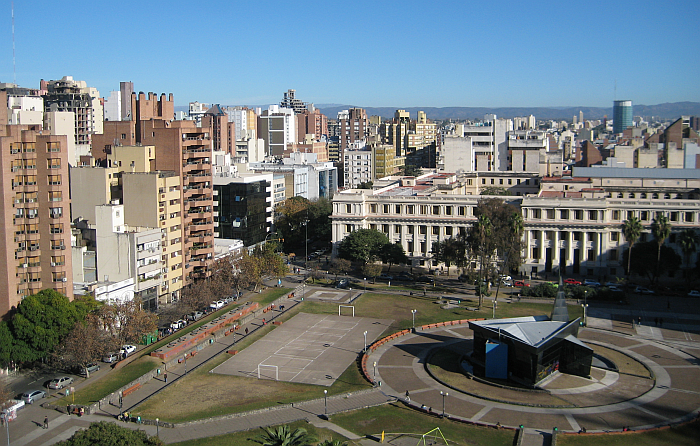
[Looking west from central Córdoba over the Palacio de Tribunales (law courts) toward the Sierras]
Córdoba shares several characteristics with other provincial “second cities” that are overshadowed by much larger national capitals. It’s rarely a primary destination for visits by foreign tourists, who typically pass through only en route to other destinations and stay only briefly. But despite a lack of marquee attractions for tourists, Córdoba has a lot going for it as a less expensive, less pretentious, more laid-back alternative to Buenos Aires for Spanish-language or tango students, digital nomads, and other longer-term visitors.
A major advantage of Córdoba is its location, which gives easy access to open spaces and outdoor activities in the surrounding countryside. Like Denver (or Almaty, Kazakhstan, to give another notable example), Córdoba is a city of the plains at the foot of high mountains. The Sierras de Córdoba that begin just outside the city are part of Argentina’s Central Sierras, the only major mountain range in the middle of the vast flat expanse of the pampas. There are tower blocks of elevator apartment in central Córdoba, but unlike in Buenos Aires, Córdoba is small enough that it doesn’t take long to get out of the city to dude ranches on the pampas (such as the one visited by The Amazing Race for a gaucho cowboy bull-roping challenge) or to hiking, camping, and mountain-biking in the mountains. Despite their isolation, the Central Sierras include significant expanse of highlands, extending more than 200 miles (400 km) from north to south and gradually rising 8,000 feet (2,500 meters) from the center of Córdoba to a peak more than 9,000 ft (2,800 meters) above sea level.
Córdoba is served by relatively few long-haul flights, with none at present to or from the USA. Direct flights on American Airlines that briefly operated to and from Miami were suspended in 2020 and have not resumed. Connections via Buenos Aires typically involve a tedious and inconvenient transfer between the domestic and international airports. The best connections to and from the USA are currently on LATAM via Santiago or Lima, or on COPA via Panama City. Most long-distance transport within Argentina, including to and from Córdoba, is by bus.
The finish line for this leg of The Amazing Race was, appropriately enough, in the Plaza San Martín in the center of city. The racers were given some characteristically Argentine tasks, including identifying cuts of beef at a butcher shop and playing a version of soccer at the historic stadium of the Talleres de Córdoba club. There was an unexplored irony, however, in one of the optional challenges for the racers: identifying fingerprints at a police forensic laboratory.
One of the most noteworthy sites of memory of state terror in Córdoba is a former office of the Provincial Police located down a passage off the Plaza San Martín, the entrance the racers ran past in their final sprint to the finish line. As I described it during an earlier season of The Amazing Race:
In Córdoba, prisoners were confined in underground pits and tortured in open-air courtyards in a small building in the Pasaje Santa Catalina (pedestrian arcade) just off the central Plaza San Martín between the city hall and the main cathedral. I struggled to imagine what passers-by, on their way to or from mass (in Argentina, unlike some Latin American centers of liberation theology, the Catholic Church and priests like Father Jorge Bergoglio, who is now the Pope, largely accommodated themselves to the dictatorship) or dealings with city bureaucrats at the Cabildo, thought when they heard the screams. Today the building houses the provincial Archives of Memory and a must-see little museum of the memory of state terrorism in the province. It’s particularly interesting for putting the “Proceso” in longer-term context: the building housed the provincial police “Red Squad”, where “subversives” were detained and tortured, long before the military dictatorship of 1976-1983. It also includes several rooms of artifacts and images of the people killed and disappeared, vaguely reminiscent of Mexican “Day of the Dead” altars but with their own Argentine flavor.
While fingerprints have been used by police in Argentina and other countries to identify both criminals and targets of state terrorism, fingerprints and other forensic techniques have also been used, in Argentina and elsewhere, to identify the bodies of victims of that state terrorism.
It wasn’t clear in what contemporary police building in Córdoba the fingerprint-identification task on The Amazing Race was supposed to take place. But the contrast with the Pasaje Santa Catalina could scarcely be more striking: One feature of the site of memory in the Pasaje Santa Catalina is a mural of the names of Córdobans who were murdered, “disappeared”, tortured, or detained, rendered in the shape of giant fingerprints on the outside wall of the police building.
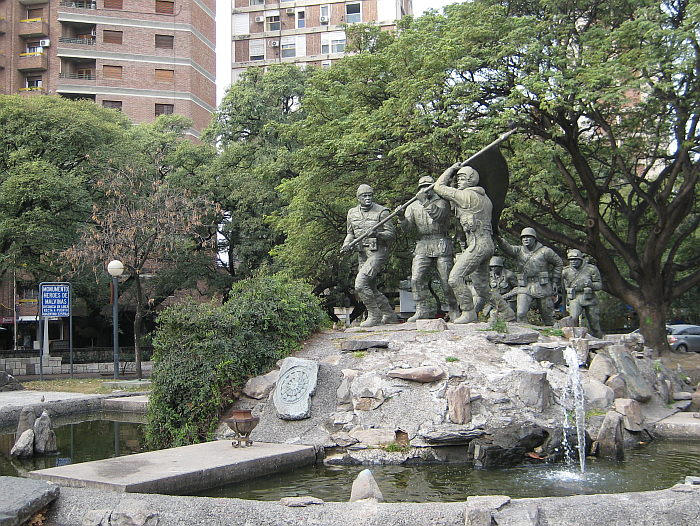
[Monument to the Heroes of the Malvinas Islands War, Plaza de la Intendencia, Córdoba]
Wednesday, 10 April 2024
The Amazing Race 36, Episode 5
Medellín (Colombia) - Santiago (Chile)
The cast and crew of The Amazing Race were flown by chartered plane, off camera, from Medellín to Santiago (with a refueling stop in Lima, Peru, the largest aviation hub in northern South America). So everything we saw in this episode took place in and around Santiago.
Like Sacramento, California, Santiago de Chile is located in a broad, largely level, central valley, two hours drive from the Pacific Ocean to the west and two hours drive from the crest of a high north-south mountain range (the Sierra Nevada in the case of Sacramento, the Andes in the case of Santiago) to the east. Many would say that relatively easy getaways to the mountains or the nearest cities on the coast (San Francisco in the case of Sacramento and Valparaiso in the case of Santiago) are among the advantages of living in either of these cities. But little of that was visible in this episode of The Amazing Race except for glimpses of the snowcapped Andes as a backdrop to the Santiago skyline.
Only those racers who got lost on the roads made it out of the city and into the surrounding foothills. And the racers didn’t visit the most obvious sign of how close Santiago is to the ocean: the vast and astonishingly diverse Mercado Central of seafood trucked in every day from Valparaiso. Santiago’s fish market ranks with only a few others in the world — including those in Tokyo (Japan), Athens (Greece), and Maputo (Mozambique) — as a local tourist attraction, and would have been a perfect site for a locavore challenge for the racers. Too bad they skipped it. If you are ever in Santiago, it’s a must to visit.
Santiago is a much larger city than Sacramento, with a lot more to see and do. That’s not a criticism of Sacramento: Not everyone wants to live in a mega-city. Even in a metropolis like Santiago or Los Angeles, many people live their lives within a short distance of their home, and are more concerned with the character of their neighborhood than with “attractions” of the region that are an hour’s drive away. Neighborhood character and choice of neighborhood in which to stay, of course, especially important in shaping your experience if you are travelling without a car, relying on foot, bicycle, and/or mass transit.
Santiago has an extensive metro (subway) system. But as in Los Angeles, and unlike in New York City, the Santiago Metro network is too thin to get you to many places of interest. Even if you are staying near a Metro station, you will need to take a bus or taxi from the nearest Metro station to get to some of the most interesting sites in the Santiago conurbation, which for me included the Parque por la Paz Villa Grimaldi.
Santiago is proud to see itself as a cosmopolitan world city, but that doesn’t mean it has to be a characterless “cookie-cutter” city. I was disappointed that the racers were given tasks and destinations (a skateboard park, a climbing wall, busking for tips as musicians in a park) that could have been almost anywhere and revealed little of Santiago’s distinctiveness. The Amazing Race often features eating and drinking challenges, for example, but this episode did nothing to show off Santiago’s culture of food and wine.
If you’re a skateboarder, you may want to skate, visit local skate parks, and meet local skaters wherever you go. That may open doors to learning more about local people’s lives and their other activities. But it’s also worth seeking out things to do when you travel that you couldn’t do at home, and that connect you with different types of people than you meet in your daily life at home. Let’s hope that future episodes of this season of The Amazing Race do more to put the racers in touch with what’s special about the places they visit.
Thursday, 4 April 2024
Silverbills is shutting down Paytrust

[New banner on Paytrust.com]
Just three months after taking over the Paytrust bill scanning service from its previous owner, Silverbills has decided to shut it down — with grossly irresponsible short notice to Paytrust customers.
Long-term gravellers, digital nomads, and expats have relied on Paytrust for more than 20 years to provide a stable U.S. address (a unique U.S. Post Office Box, not a “private mailbox” or the like, for each Paytrust customer) to which they could have all their bills sent for scanning, online viewing, and online payment through a single Web interface.
Silverbills is not the first company to give up on making Paytrust sufficiently profitable and shut it down (or threaten to do so). Owners of Paytrust since its founding as a standalone dot-com startup in the 1990s, funded by venture capital, have included Intuit and later the huge business payment processor Metavante. Silverbills — itself a startup funded by venture capital, which may or may not have made it to profitability — took over Paytrust as of 1 January 2024 after the most recent previous owner announced plans to shut down the Paytrust service in mid-2023.
The banner announcing that Paytrust “will cease operations and shut down on May 3, 2024” appeared at the top of the Paytrust.com home page on April 3, 2024. As of today, the Paytrust.com Web site gives no further details. Below the shutdown banner, the home page is unchanged, including a list of planned “New Features Coming in 2024”.
The banner on Paytrust.com refers to “the emails sent on April 2, 2024 from Paytrust and Grasshopper Bank”, the bank which provided a pass-through account for processing each Paytrust customer’s payments. In response to a request for comment, Silverbills’ director of sales also referred me to e-mail supposedly sent by Paytrust:
The only e-mail messages I received on April 2nd from Paytrust, or have received since then, were routine notices of bills, payments, and charges, with no mention of any planned changes to the Paytrust service. As of today, the only e-mail I’ve gotten about the planned shutdown is a message April 2nd from Grasshopper Bank, copied below in its entirety:Please reference all details sent in the Grasshopper Bank and Paytrust emails that were sent for further details about the termination of services.
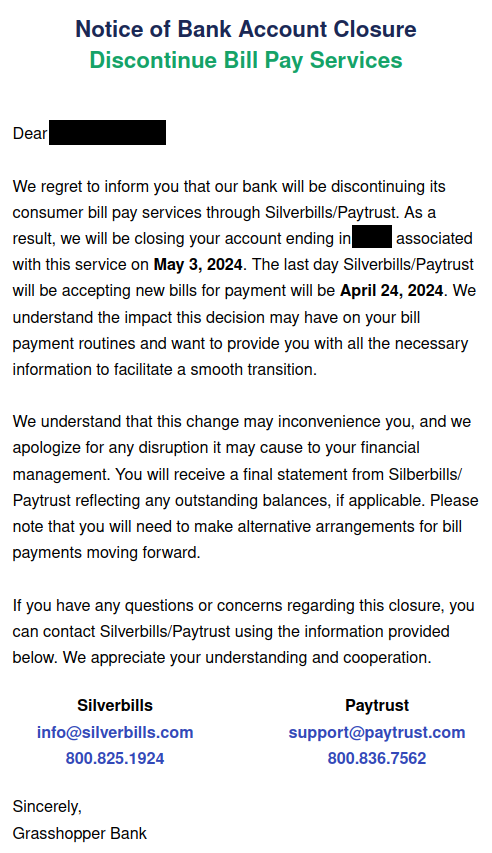
[E-mail message to Paytrust customers from Grasshopper Bank, 2 April 2024]
It’s unclear from this message whether Silverbills is going out of business entirely, or is shutting down the Paytrust service while continuing to offer its more expensive “concierge” bill payment service under the Silverbills brand — and, if the latter, whether Paytrust customers will be given the option to transition to the Silverbills service while keeping the same P.O. Box for billing.
Investors used to speculating on startups like Silverbills may not know how to manage or assess the value of an ongoing business with long-term customers like Paytrust. It’s possible that the investors who have been funding Silverbills have cut off further funding without warning. When venture capitalists decide that a venture in which they have invested has failed, and that it’s time to pull the plug, they don’t tend to have much concern for the impact on either their employees or their current customers.
Having a service that you rely on to enable your nomadic or expatriate lifestyle shut down while you are abroad can be disastrous at best (unpaid bills, cancelled insurance, damaged credit rating, etc.) and a time sink at best. This is especially true if it’s not a commodity service for which you have mnay choices of providers if one shuts down, and if you don’t have enough warning to make the transition smoothly. Stability is far more important than cutting-edge services when digital nomads are choosing providers for their personal financial infrastructure.
My advice to Paytrust customers this time around is pretty much the same as it was when the previous owner announced plans to shut the service down last year, with the caveat that switching to the Silverbills concierge-level service may or may not be an option and probably isn’t one you should choose except as a temporary stop-gap measure while you put some other arrangements in place.
By shutting down the Paytrust service with only one month’s notice, Paytrust is showing itself to be a grossly irresponsible company that you shouldn’t trust with any critical tasks. Changing your billing address to get all your bills sent to a new address will typically take a couple of billing cycles, and can’t usually be completed in just a month. Some bills will still arrive at Paytrust customers’ P.O. Boxes after Paytrust shuts down. If those bills are unscheduled and unexpected, some of them will go unpaid. Paytrust is risking huge liability by shutting down so quickly. But if the parent company (Silverbills) is going out of business, customers will be unable to collect any damages from a bankrupt entity or dissolved corporation.
Many questions remain for Paytrust customers, especially with respect to mail addressed to their Paytrust P.O. Boxes. Will those bills be returned as undeliverable, “Box Closed”? Will Paytrust forward them, and if so, for how long (and perhaps at what price)? Will Paytrust put in forwarding orders for those boxes with the U.S. Postal Service, or can Paytrust customers do so? Can Paytrust customers take over rental of the P.O. Boxes that have been assigned to them by Paytrust? The USPS charges a fee in some cases for forwarding mail received at a PO Box, but it may be well worth the price for Paytrust customers, if it’s possible, at least for six months or so until all bills are being sent to a new address.
What may be most unfortunate about the shutdown of Paytrust for long-term travelers, digital nomads, and expatriates is that it may discourage other companies — old or new — from trying to offer a similar service, even as the growing number of digital nomads gives it a much larger market than ever before. Paytrust wasn’t fancy and wasn’t perfect, but it seemed, from a customer’s perspective, to have solved mnay of the operational problems of a bill scanning service, and to have operated for 20+ years with a sufficient level of stability and reliability. If it wasn’t profitable, I think that was likely a problem either of management or (perhaps more likely) of marketing, not an indictment of the Paytrust service model.
I’ve invited Silverbills to provide more information, and will update this article and/or post a follow-up if I learn more.
Wednesday, 3 April 2024
The Amazing Race 36, Episode 4
Guatapé (Colombia) - Medellín (Colombia)
Colombia was an apt destination to include in this season of The Amazing Race. It’s one of the destinations (along with Mexico, which the reality-TV show visited earlier in this season) that most increased its share of international visitors even during and after the COVID-19 pandemic, when international tourism was greatly reduced.
How could that be? The key to this apparent paradox is that Colombia in general, and Medellín in particular, has become one of the most popular destinations in the Americas — again, after Mexico — for a category of international visitors who are neither traditional tourists nor traditional expatriates: “digital nomads” or remote workers who are living in the country for extended periods, but not permanently or with any commitments, while working for employers or clients in higher-wage countries elsewhere.
In the first edition of The Practical Nomad: How to Travel Around the World, published in 1997, I recommended that would-be world travellers without jobs lined up abroad in advance save up enough before their departure to cover the expected cost of their trip, rather than planning to make any significant amount of money along the way. Countries that are inexpensive to travel in tend to be ones where wages for locally-available jobs are low, and the competition for those jobs is high.
I still think that was good advice at that time. It wasn’t until much more recently that sufficiently fast, reliable, and inexpensive Internet connectivity became available in even big cities in many parts of the world. I remember the frustration of trying to e-mail large files and confer with my editor in the USA on first-generation voice-over-Internet phone calls over unreliable slow Internet connections — the best available in the wealthiest and best-connected neighborhood of the national capital — from cybercafes in Quito, Ecuador, in 2000.
Remote work was technically feasible by 2020, the last time “The Amazing Race” visited Colombia, but it wasn’t yet an option most employers would consider. That season was filmed just before the start of the COVID-19 pandemic but broadcast at the pandemic’s peak. It wasn’t until employers were forced to send all their office workers home that they recognized the possibility of remote work as we now know it, or became willing to hire remote workers for most “office” jobs.
It’s important to keep in mind that remote work still isn’t possible for everyone. Office work has, for the most part, gone remote, but fortunately the world isn’t just one big office. (Insert the “office work takes over the world” dystopia of your choice here.) Billions of people around the world do work in agriculture, forestry, mining, manufacturing, production, processing, distribution, and — last but far from least —- services that has to be done on site or close by. A change of careers to one that allows for location-independent employment isn’t feasible for some people, and would entail a dramatic reduction in income for others. Freelance work, even on site, tends to give less income security than a salaried job as an employee, a risk not everyone can afford to take, especially in countries without much social safety net. Assuming that anyone who isn’t living a nomadic lifestyle as a remote worker is staying settled by choice, or could become “location independent” if they wanted to or if they tried, is naive.
But if remote work isn’t the answer for everyone who can’t afford to travel without earning some money along the way, employers’ openness to remote work for office-type jobs has made it an option for a large class of (mostly already relatively elite) workers.
How does this play out in the places like Medellín where digital nomads have become a visible presence? Local reactions to foreigners without local roots or connections who pass through or hang around for weeks or months as remote workers for foreign employers or clients, while deliberately not trying to put down roots, are decidedly mixed.
Most local people are pleased that people who could choose to live (almost) anywhere in the world are choosing to live in their city or town, and are choosing to stay longer than typical tourists (if it’s even a place that attracts tourists, which Medellín for the most part isn’t). Staying longer in each place than tourists gives digital nomads more of a chance to engage with, learn about, and learn from local people, if they want to. Some of that is inevitable if you are living in a rented apartment, even in a neighborhood with many other foreigners, rather than staying in a hotel or hostel. Like tourists, digital nomads buy some local products and support some local jobs, mainly in service industries, although these aren’t necessarily good jobs.
Some, although not all, traditional expatriates — foreigners who are doing work for local employers or in the local operations of foreign companies, rather than “location independent” work for employers or clients elsewhere — live in formally or informally segregated expat neighborhoods or gated compounds. But except for those in the most fortified and isolated enclaves (such as some military bases and oil, gas, and mining sites), their work tends to give them some connection to local co-workers. Some digital nomads, on the other hand, spend all their work time in Zoom meetings in English with colleagues back “home”, and don’t necessarily have any opening to interact with local people as peers, only as service workers.
Digital nomads may feel that they have “gone local” and immersed themselves in the place where they are (temporarily) living, but local people may see them as living lives detached from local reality except as consumers of attractively inexpensive (because local wages are low) services. Their very identity as location-independent workers and “nomads” can come across, even if unintentionally, as a deliberate renunciation of interest in learning about where they are and the people who are settled there and will still be there after they move on, or even as deliberate indifference to their impact on local people who don’t have the option to leave.
The privilege of working remotely around the world is available primarily to those already privileged in many other ways, including the privileges of first-world citizenship (passports that allow month-long stays without visas) and white-collar occupations. That’s part of the reason that the influx of digital nomads has provoked a backlash of resentment in some of the places where they have converged. The apartments they are renting are mostly ones in preferred neighborhoods and types of buildings that only a minority of local people, even those with comparable training and skills, could afford. Digital nomads who are willing to pay more for short-term rentals help drive prices out of reach for even upper-middle-class locals who might have aspired to live in these places.
Colombia isn’t a major destination for tourists from the USA or elsewhere in the global North. There are no globally-known marquee attractions in Colombia. (Quick: Can you name some place or thing you would go to Colombia, rather than anywhere else in the world, to see or do? I didn’t think so.) Colombia is a cheaper country in which to travel or live than the USA, but not as cheap as many other countries.
As a “middle-income” country, however, Colombia is in the sweet spot for digital nomads. It has sufficiently “first-world” infrastructure, connectivity, and creature comforts, at substantially less than first-world prices.
It’s indicative of the current patterns of travel to Colombia that my fellow travel writer Tim Leffel omits Colombia from his current short list of the world’s cheapest destinations for tourists, but rates it among the top places to live abroad for less than the cost of living in the USA.
Buenos Aires, the South American city most popular with digital nomads, is cheaper (depending on the vagaries of inflation and exchange rates) for comparable comfort, and generally safer than Medellín despite being a much bigger city. There are probably more North American and European remote workers in Buenos Aires than anywhere else in the Americas south of Mexico. But because Buenos Aires is so much larger than Medellín, and has many other foreigners — both tourists and permanent and semi-permanent expatriates — digital nomads are a smaller proportion of foreigners or of the total population. In Medellín, a smaller city with relatively few gringo tourists, digital nomads have become a visible presence that for many locals defines the image of the “typical” foreigner.
Colombia has the advantage for remote workers or those who need to come back home from time to time of being only half as far away from the USA as Buenos Aires, and in one of the same time zones as the USA (Central or Eastern time depending on the time of year, since Colombia doesn’t use daylight savings time). Medellín has big-city infrastructure and amenities, high-rise urban living in some neighborhoods, and non-stop flights to Miami and New York, but for foreigners considering where in Colombia to go for a few weeks or months, Medellín probably seems less overwhelming and intimidating than mega-city Bogotá.
These are issues whether or not we travel, of course. The difference is that digital nomads and residents of their host countries are more likely to confront them face to face and not just see them on TV. The comforts of our lives in the USA are made possible by the difference between our incomes and those who are paid less because they live in countries where wages are lower, and can’t get permission to move to places where wages or higher, or who are paid less even in the USA because they came here without permission. Rarely do we need permission to visit their countries. The holders of U.S. passports are the world’s greatest beneficiaries of non-reciprocal visa and entry rules.
Digital nomads are arbitraging disparities in wages, costs of living, and passport privileges that would be largely leveled if people could move across borders as freely and goods and capital. That doesn’t mean that I think they are doing anything wrong. I’m one of them, and I was a “digital nomad” before this phenomenon had a name. I’ve worked remotely from abroad, from Buenos Aires and elsewhere, never establishing residency outside the USA. I had unusually enlightened employers who allowed this long before COVID-19. I’ve lived and travelled in a way I couldn’t have afforded on a local salary. But it’s important to recognize what enables this lifestyle. I’ve devoted most of the last twenty years to the struggle for recognition of freedom of movement as a human right. Sadly, it remains a privilege limited to those who hold passports from wealthy countries.
Wednesday, 27 March 2024
The Amazing Race 36, Episode 3
Puerto Vallarta (Mexico) - Medellín (Colombia) - Guatapé (Colombia)
This week’s episode of The Amazing Race 36 was set in and around Guatapé, a tourism-dominated town that’s a popular excursion or weekend getaway from the city of Medellín, two hours away by bus.
The marquee attraction in Guatapé is “El Peñón de Guatapé”, an isolated vertical-sided rock 200 meters (650 feet) high, with a stairway built up one side to a viewing platform on top. At least one of the racers was afraid of heights, but perhaps they should have been as worried about being immediately below the rock (and without hardhats!) as of being on top of it. In November 2023, a year after this season of The Amazing Race was filmed, a landslide onto the path around the base of the rock injured 17 tourists.
The town of Guatapé is on the shore of a large reservoir behind a dam built for water storage and hydroelectric power for the Medellín region, which the racers — like many visitors — explored by boat. The decision to build the dam, which required relocating an entire town (only the cross on top of the steeple of the largest church, featured in this travelogue by a Colombian YouTuber, remains visible above the water of the reservoir), was controversial. But like many such human-made lakes, the reservoir has become a major recreational site.
Coffee is Colombia’s second-largest cash crop and source of employment and export revenues after cocaine. This leg of the race ended at a coffee hacienda (“finca”) where one member of each pair of racers had to pick and hull enough ripe coffee cherries to produce a kilogram of raw coffee beans.
For most tourists, coffee tourism has more to do with the lives of plantation owners than with the labor of coffee pickers.
When we think about labor-intensive farm work, the first things that come to mind are likely to be cotton, sugar cane, and rice. But today cotton can be picked, sugar cane can be cut, and rice can be transplanted by machine (or seeded directly in paddies without transplanting).
Coffee, tea, and cocoa, however, can’t be produced without large numbers of field workers. Cocoa harvesting involves cutting the large pods off the tree with a machete, and then slicing them open to extract the beans. So far as I can tell, those processes haven’t been automated. Coffee berries and tea leaves can be picked by machine, but (1) picking machinery is harder to use on the steep slopes where these crops grow best, and (2) because not all the coffee cherries or tea leaves on a bush are ready to be picked at the same time, mechanized picking inevitably results in less-than-optimal timing. The highest quality coffee and tea is picked by hand, returning to each bush several times during the ripening season to select the cherries or leaves that are ready to be picked.
Whether we live in a country where people drink more coffee or more tea, we probably don’t think much about how it is grown. “I’ve never seen a coffee plant,” one of the racers said, while another noted that, “I’ve never heard of a coffee cherry”. As yet another of the racers, Kishori, observed:
That was a hard job. I have so much respect for the people that do this. We eat food, we just see it on our plate, but we don’t actually appreciate where it comes from sometimes. That kinds of puts things in perspective, like how much hard effort actually goes into putting it on your plate.
Props to the producers of The Amazing Race for giving racers and viewers a glimpse of field work in the coffee country.
Stay tuned for the next episode, when I’ll have more to say about Medellín.
Thursday, 21 March 2024
US Department of Transportation to investigate airline data privacy
Today the U.S. Department of Transportation (DOT) announced plans for “a privacy review of the nation’s ten largest airlines regarding their collection, handling, maintenance, and use of passengers’ personal information.”
The review will include airlines’ compliance (or not) with the so-called Privacy Shield framework for transfers of personal data from the European Union to the US. As DOT notes on its website, “DOT is the enforcement authority for airlines participating in Privacy Shield. DOT shares jurisdiction with the FTC regarding ticket agents participating in Privacy Shield.”
This is a positive step, but I’m reserving judgment until I see what DOT actually does.
According to DOT’s press release today, the review of airline privacy practices has been assigned to DOT’s Office of Aviation Consumer Protection, which at least in the past has been extremely resistant to taking on what it knows could be a large new body of work, for whihc it has has no in-house expertise, policing the privacy and data protection practices of the airline industry.
The FTC has more expertise and enforcement experience than DOT with respect to consumer privacy issues, but DOT has been extremely resistant to collaboration with the FTC. I and several comsumer organizations submitted comments to the FTC’s privacy roundtables in 2009 urging coordination of FTC and DOT work on privacy issues to close the jurisdictional and enforcement gaps between them, but nothing happened. I raised this issue again, along with other recommendations for action, as the sole non-governmental, non-industry expert witness invited to testify at a meeting of DOT’s Advisory Committee on Aviation Consumer Protection in 2013 devoted to the privacy of airline reservation data. FTC staff attending that meeting said they were willing to share their privacy expertise with DOT, but only if DOT asked for it, which it hadn’t.
The terms of reference for the review, as described in DOT’s press release today, make it unclear whether DOT will be looking into how personal information in airline reservations is made available to US and foreign governments, or whether DOT’s review will be limited to commercial use of airline data. It’s also unclear whether the review will be limited to airlines themselves, or will also include the computerized reservations systems to which airlines outsource hosting of their reservation databases.
DOT says that it consulted the office of Sen. Ron Wyden (D-OR) in developing its plans for the review. It’s not clear who else they consulted or will consult.
To answer the question I’ve already gotten from some readers: Despite being the leading independent expert on this issue and the leading advocate for decades of the need for action by DOT with respect to airline reservation privacy, I was not consulted and had no idea that this was in the works. I’ve contacted Sen. Wyden’s office to offer my assistance to him, his staff, and DOT’s investigators in identifying “where the bodies are buried” in airline privacy invasion practices.
Stay tuned.
Wednesday, 20 March 2024
The Amazing Race 36, Episode 2
Puerto Vallarta (Mexico)
Like the season premiere last week, this second episode of The Amazing Race 36 took place entirely in Puerto Vallarta — but in an even smaller area, with the cast members travelling from each checkpoint or challenge to the next entirely on foot.
Without maps, or with maps that didn’t show the landmarks they needed to find, the racers relied on asking passers-by for directions. That worked surprisingly well, even for those racers who didn’t speak Spanish. They were helped by the fact that Puerto Vallarta has one of the largest concentrations of of American expats — a mix of US and Canadian retirees and digital remote workers — of any city in the world. Many of the people who gave the racers directions appeared to be “gringo” local residents. Many of these informants also appeared somewhere between bemused and disgusted at the behavior of racers shouting the name of their destination randomly into a street scene. Even in a race, you are more likely to get good directions if you ask a specific person rather than calling for help from the world at large. Save general alarms and shouting for help like that for real emergencies.
Pick someone to ask for directions who doesn’t look too busy already. If you know a local language, preface your question with a greeting and an apology for bothering them. If you don’t know their language, start with, “Excuse me. May I speak English?” — and then a greeting if they do speak English. There are places and cultures, including some in the US, where it would be rude in the extreme to ask directions without first attempting a minimal self-introduction and exchange of pleasantries.
It was hot and humid, and the cast of The Amazing Race had been out in the sun all day. Several members of the cast, including one member of the team that finished last and was eliminated at the end of day, had to take breaks to recover from heat exhaustion.
It may be tempting to say that stopping to rest cost them the race, but it’s equally true that stopping to rest (or getting your travelling companion to to do) before heat exhaustion progresses to heat stroke could save a life.
Heat exhaustion is a consequence of heat and humidity, but it’s also a result, in many cases, of impatience and/or cultural insensitivity.
A common cause of heat exhaustion is trying to keep up with the pace being set by a tour group, or being unwilling to acknowledge one’s physical limits. Real-world travel doesn’t need to be a race or a physical competition, and isn’t usually improved by speed. Slow travel has many of the benefits of slow food.
What does heat exhaustion have to do with culture? An anthropologist starts with the assumption that even the strangest-seeming cultural practice serves some function, and tries to figure out what that is. Tourists are often well advised to do likewise, and not to dismiss local customs without first asking if they serve a purpose. The observation that, “Only mad dogs and Englishmen go out in the mid-day sun” is a comment not about anything distinctively English but about cultural arrogance in general, and its dangers. There’s a reason for the prevalence in hot climates of the mid-day siesta followed by the evening promenade and/or night market. That’s the tradition in Mexico, including in Puerto Vallarta, except where tourists have imposed their demands for businesses to stay open through the hottest part of the day.
Wednesday, 13 March 2024
The Amazing Race 36, Episode 1
Los Angeles, CA (USA) - Puerto Vallarta, Mexico
For season 36 of The Amazing Race, filmed in October 2022, the producers of the “reality” TV show once again chartered a plane to fly the cast and crew between stops. The starting line and this entire first leg of the race were in Puerto Vallarta, Jalisco, on the Pacific coast of Mexico.
Since the racers didn’t have to deal with any flights or long-distance transportation, it was the issues they faced within the city that determined the order of finish of the pairs of contestants. Despite some contrived challenges, the racers faced three major tests of real-world urban travel skills:
1. City driving, navigation, and parking
The racers were required to drive themselves around the city in rental cars. The TV producers didn’t give the racers a choice, but their difficulties highlighted the dubious wisdom, if you do have a choice, of renting a car to get around a dense, unfamiliar city. Even those racers who spoke Spanish had difficulties with driving, parking, and/or navigation.
You can’t count on streets being laid out in a grid, and driving and navigation can be a lot harder in a city than on highways. City street signs are typically smaller and harder to pick out of visual clutter than highway signs. The closer you get to the city center, the more likely you are to encounter pedestrianized streets closed to cars (not always obvious from paper or online maps), one-way streets, dead ends, and parking rules and restrictions that can be inscrutable even if you pull over and get out of your car to read the fine print on the parking signs.
Sometimes parking fees can be paid only through some sort of prepaid parking card only available at limited sales outlets, or through an app that’s only available in the local language or requires a local address, phone number, and/or bank account. One team of racers almost got trapped in a dead-end alley, seeming not to realize that they needed to back out instead of trying to turn around. Another team lost time trying to figure out where near the malecón (beachfront promenade) they could legally park.
Some of the contestants had prepared for The Amazing Race by practicing driving in an unfamiliar city with a (paper) map, since they knew that they wouldn’t be allowed to bring smartphones with them on the race. That’s a good idea for real-world travellers: There will be times, especially (but not only) when you have just arrived in a new country, when you don’t have cellphone coverage or mobile data roaming, and thus don’t have access to maps on your smartphone unless you’ve downloaded maps in advance for offline use.
Even if your cellular provider has a roaming agreement with some Carrier X in Country Y, you might find yourself in a part of Country Y served only by Carrier Z. Or your cellphone might not support the frequencies used in Country X by Carrier Y. You can avoid some of these problems if you always remember to download maps, before you leave for any new country, for everywhere you might go in that country. But the odds are that sooner or later you’ll forget to do that until it’s too late. Murphy’s Law says that will be the country where roaming doesn’t work and there are no cheap local SIM cards (or none that work with the bands your cellphone supports) for sale at the airport or border crossing.
Paper maps are getting harder and harder to find. Sometimes you won’t have any map at all to go by — again, especially if you’ve just arrived and didn’t think to bring a map with you. The racers realized too late that in addition to map-reading they should have practiced urban navigation without a map, relying on signs, landmarks, and/or directions from passers-by.
Understanding and following verbal directions, even if you speak the language, is different from following a map or turn-by-turn directions from a smartphone. The racers regretted that they hadn’t practiced this skill. If you ask people how to get somewhere, they may giver directions by reference to landmarks rather than by route, and may describe streets by attributes or appearance rather than by name. If you want their help, but you can’t understand their mental map, that’s your problem, not theirs!
2. Wheels on cobbles
Cobbled or other stone or brick streets or sidewalks are rare in the USA, but common in some other parts of the world, perhaps especially in older European and Latin American city and town centers. The neighborhoods with streets and sidewalks like this are often among those most visited by tourists. And they may be precisely those streets that are too narrow or too steep for taxis or other cars, or from which they are prohibited.
The racers had to carry or drag large hobby-horses along cobbled streets down a steep hill. The hobby-horses had wheels, but the racers quickly discovered that wheels — especially small wheels like those on the hobby-horses or typical wheeled luggage — don’t work well on cobbles, bricks, or paving stones; on badly broken pavement, unpaved lanes, or hilly streets that turn into steps; or on soft sand, mud, or loose gravel.
Wheeled luggage is, in most of today’s world, an improvement on the prior art of luggage that you actually had to “lug”. But there remain places — including some of the world’s most popular tourist destinations — where dragging wheeled luggage over the cobblestones will be a fairly arduous task. Keep this in mind when you are choosing luggage.
In the USA and some other places where I’m confident of finding more or less smooth asphalt or cement sidewalks and pedestrian paths, I sometimes rely on a “rollaboard” suitcase. But for trips to places where I know cobbles and paving stones are common, or where I’m less sure what to expect, I still use a convertible suitcase that has both wheels and backpack straps. I use the backpack straps only rarely, and they add some weight. But for the times I would otherwise have to drag my suitcase over cobblestone for half a mile into the center-city pedestrian zone to my hotel or hostel, or up or down a long hillside of steps, it’s worth it to me to have them available.
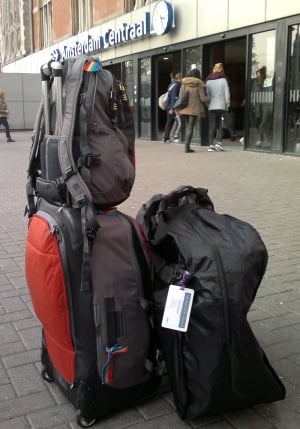
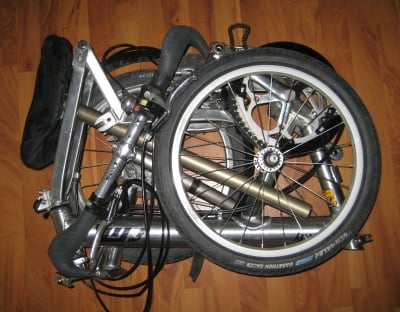
[My luggage arranged for wheeling through the main station in Amsterdam and onto a high-speed train on a multistop European trip: convertible wheeled backpack, detachable daypack, and folding bicycle in carrying bag. The orange panel on the left covers the backpack straps and padded frame.]
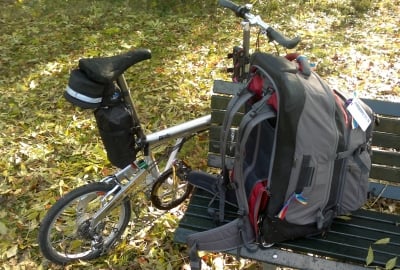
[The same luggage set up to carry on my back, with the bike unfolded, the daypack attached to the backpack (at the right-hand side of the photo), and the backpack straps and waist beltmunfolded.]
It you aren’t sure of your own preferences, or whether convertible luggage would be worth the extra weight, here’s a test you can do even if you don’t have any cobblestone streets nearby: Find a coarse, loose gravel road — the worst road you can find, a road too rough to bicycle on — and test what it’s like to drag or carry the luggage you plan to bring on your trip, loaded with the mount of weight you expect to have, for a substantial distance along that rough road.
3. Separating signal from noise
In a challenge that would seem at first glance to have little to do with real-world travel, the racers had to watch a brief lucha libre “battle royale” with ten fighters in the ring at once, and then correctly identify which luchadores had paired off against each other.
Lucha libre has structure and norms, and each luchadore wears a unique and iconic mask designed to make it easy to identity them. For a lucha libre fan, the task for the racers wasn’t intrinsically any harder than for fan of U.S. football to describe who blocked whom in a play they just watched. But the racers didn’t know what to expect, and found it hard at first to make sense of what they were seeing. Most of the racers had to watch a few repetitions before they could match the pairings with the fighters’ masks.
This is the typical pattern of culture shock: When a scene is completely unfamiliar, we don’t have a filter we can automatically apply to separate what’s significant from what’s not, or a contextual framework within which to organize our impressions and reduce complex bursts of movement to easily-remembered notations on our mental scoresheet like “6-4-3 double play”. When we don’t know what to focus on, we are vulnerable both to misdirection (sometimes enabling snatch thievery) and to sensory overload. To a local, for whom the patterns are familiar, it might not even seem noteworthy that a lucha libre exhibition was being staged in the plaza as they walked by.